
Semester One Final
Keith Haring
Keith Haring (May 4th, 1958 - February 16th, 1990) was born in Pennsylvania to Joan and Allen Haring. From 1976 to 1978 he studied commercial art at Pittsburgh's Ivy School of Professional Art. He eventually lost interest. Influenced by reading The Art Spirit by Robert Henri as well as the work of Pierre Alechinsky and the sculptor Christo, Haring moved to the Lower East Side of New York in 1978 to study painting at the School of Visual Arts. He developed his pop art style that he would become known for, as well as reoccurring characters such as the "Radiant Baby". He first gained attention from his public art on subways and had his first significant exhibition at the Pittsburgh Arts and Crafts Center in 1978. As he gained recognition, he was commissioned to paint many large colorful murals. His art was often a form of social activism, as it advocated for safe sex, AIDS awareness, and LGBTQ+ rights, as well as bringing awareness to the crack epidemic. He passed away due to AIDS complications. His last piece is called The Life of Christ. It was carved out of clay and cast in gold. Nine editions of it exist, and the one I looked at is housed in the Grace Cathedral in San Francisco. I was driven to Keith Haring as an artist because of the incredible activism and philanthropy that Haring was able to achieve with his work. His work started from incredibly humble beginnings and, even as he gained popularity, was still considered graffiti by many. This very casual, expressive, colorful pop art style helped to expand the definition of what could be considered art. I am always drawn to art that pushes for social change, and Haring managed to do so while making sure his art was incredibly accessible to everyone.
.jpg)
Haring in 1985

Some examples of Haring's work and style

The Life of Christ (1990) in Grace Cathedral, San Francisco
Plan

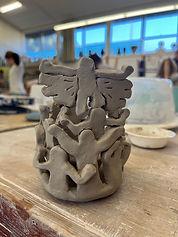
My plan was to make the design of The Life of Christ as a lantern. I planned to make the base of the lantern as well as the candle holder within using a pinch pot method. From there, I would roll out a slab of clay and, using a fettling knife and a needle tool, cut out the characters depicted in the piece. I planned to layer these figures and build up to create the lantern, leaving the top open to allow smoke and heat to escape. I planned to do two layers of the people that make up the crowd, and then add the angels, what appears to be God and the baby Jesus, and symbols such as the heart and the sun. I chose not to include the cross even though it is a central component of the piece because I am personally not religious and I planned to display this in my home, which I would not want to do if it had religious imagery. Beyond this, I consider the human and angelic figures in the piece to be more of an important focal point.
Work In Progress Pictures

November 14th

November 19th

December 9th
Final Photo


December 3rd
December 5th

December 10th
Reflection
When I got my piece out of the kiln, it had essentially shattered. Besides the bottom two rows, everything had broken off and apart. I believe this is because, as I made this piece, it often dried in between days that I was working on it. This meant that I was slipping and scoring the next row of figures onto mostly dry clay, preventing it from fully connecting. Another cause of this piece's failure is that, the bottom two layers, which stayed intact, were more securely connected than the rest of it. I was putting part of the top figure behind the head of the bottom one and smoothing the clay out, creating a more complete connection. I stopped doing this after the second row because I was worried it was going in too much and it would be impossible to put a candle in by the end. However, this sacrificed the sturdy connection that I had given the bottom two rows.
Overall, I am unhappy with this piece. Although I started it in mid November, I miscalculated how long cutting out the individual figures would take, and I ended up still being very short on time. I did not take the care necessary to make sure such a fragile piece would be sturdy.
In the future I will both allocate more time than I think is necessary for large pieces such as this and make sure that I am adequately slipping and scoring for the piece to stay together. I have also learned the importance of not adding onto nearly dry clay, and in the future will both store pieces better so that they do not dry out like this and, if necessary, start over on a piece so that it works out better in the long run.